
Replacements, widening & aprons
Concrete Driveways in Tucson, AZ
The right base, thickness and slope for a driveway that takes daily traffic, summer heat and monsoon storms.
- Free on-site measuring visit
- Written quote with each part of the job priced on its own line
- Pours scheduled around summer heat and monsoon storms
A Driveway That Holds Up in the Desert
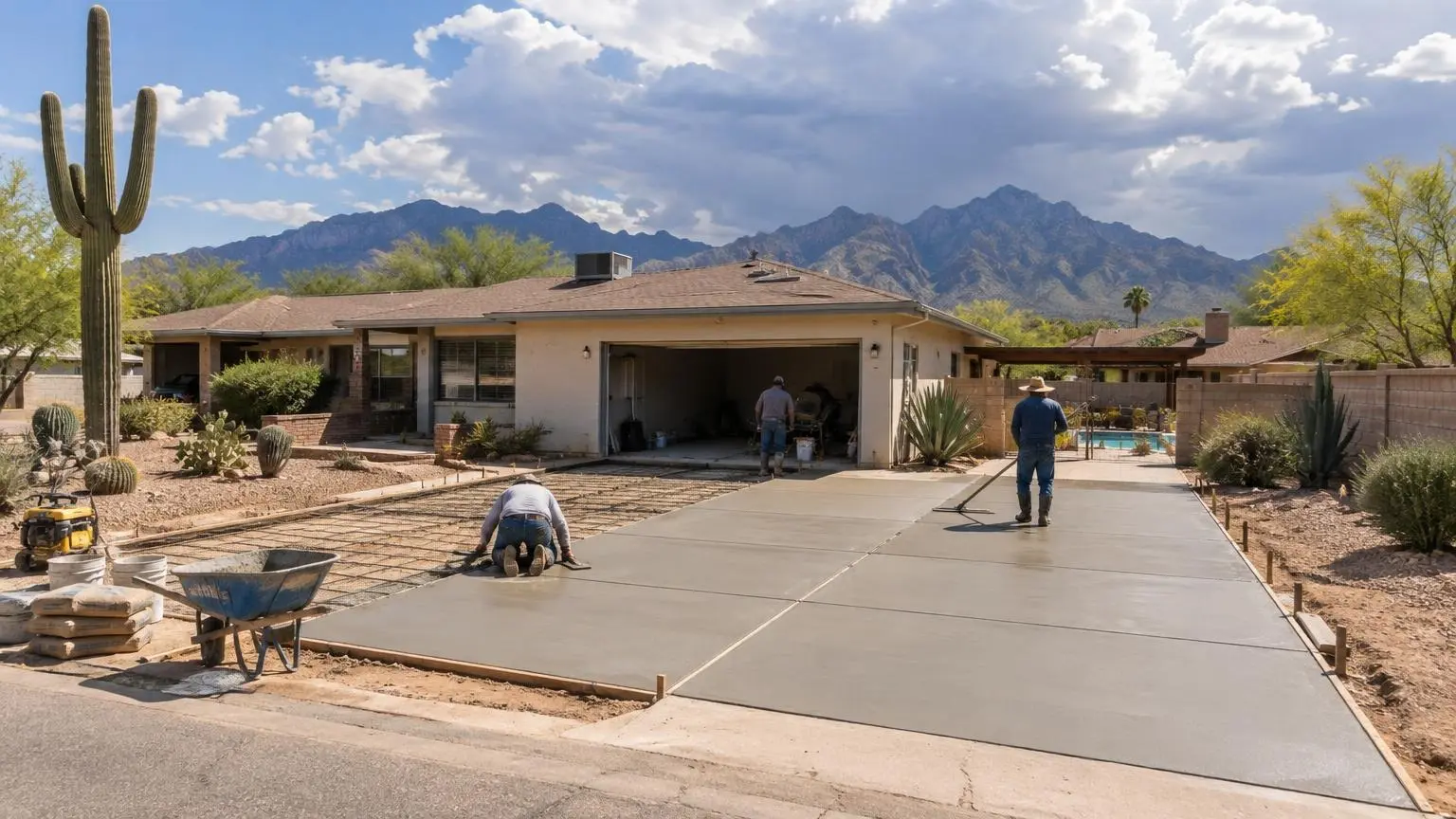
Concrete driveways in Tucson carry cars every day under strong sun, and every summer they also carry storm runoff from the roof, the street and the neighbor's yard. Many of the driveways we see were poured with homes built between the 1950s and the 1980s, which means they have been through decades of heat and monsoon seasons. Some were built for one car and a carport, and households now park two or three vehicles plus a trailer.
Signs it is time for a new driveway
- Cracks that keep widening, or cracks where one side sits higher than the other
- A section that has dropped and holds water after a storm
- Runoff that flows toward the garage or the house instead of away from it
- A broken apron at the street or crumbling edges along the gravel
- Large areas of flaking or a surface worn down to the stone
- A width that no longer fits what you park
One sunken section on an otherwise solid driveway can often be lifted, and a worn surface can sometimes be resurfaced. When cracking, settling and surface wear all show up together, replacement is usually the better use of money.
What goes under the concrete
Most driveway problems start below the surface. We break out the old slab, remove soft soil and loose fill, and dig through caliche where needed to reach the right depth. Then we place and compact a base that supports the slab evenly. Forms are set so the finished driveway falls toward the street, with no low spot at the garage door.
Thickness depends on use. HomeGuide's driveway guide calls for at least 4 inches for standard cars, 5 to 6 inches for RVs and heavy vehicles, and thicker edges of 6 to 8 inches. If a boat, trailer or work truck will park on part of the drive, we thicken that area.
Pouring in the heat
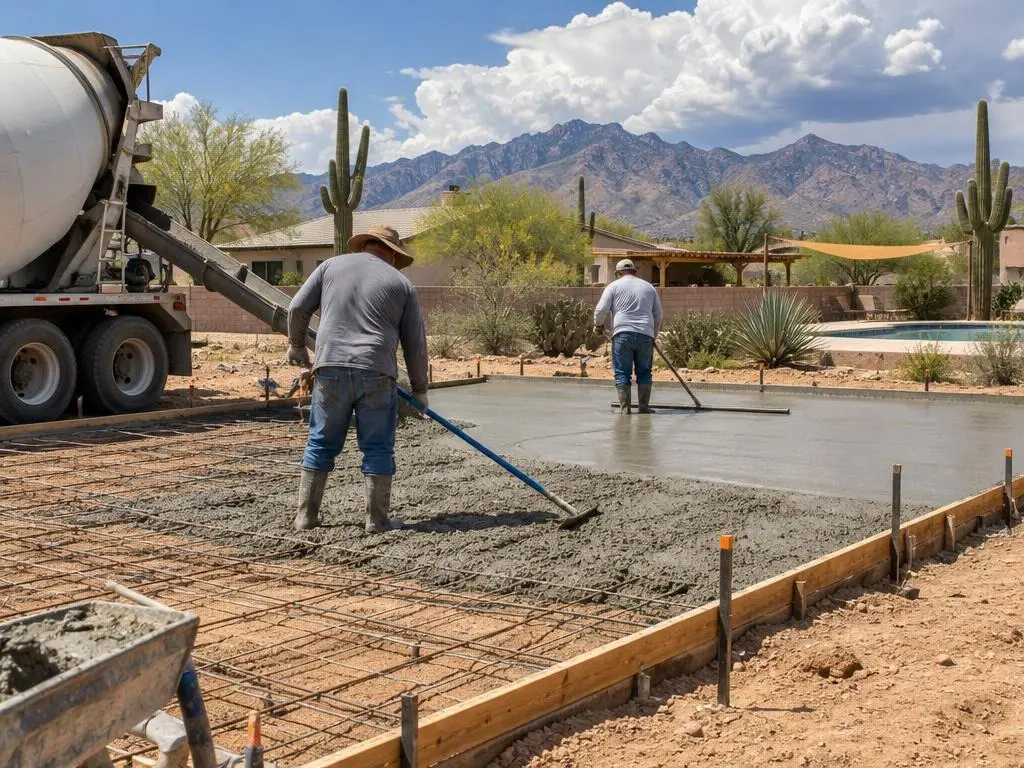
In the warm months we start pours early in the morning, wet the base before the concrete arrives, and keep enough finishers on site that the surface is not rushed. Curing begins as soon as the broom finish is done. Control joints are cut on a planned grid so the cracks that all concrete develops follow straight lines instead of wandering across the slab.
Work at the street
If your driveway meets a public sidewalk or curb, that part of the job is in the City of Tucson's right-of-way. The city's right-of-way brochure lists driveway and sidewalk installs as work that needs a right-of-way permit from the city's transportation department, with a site plan attached and a typical review of about five working days. City code also says no public sidewalk may be repaired or installed without a written permit. We include that step in the schedule so the job does not stall on pour week.
Finish options
- Broom finish: the standard choice, with a light texture that gives grip when the surface is wet.
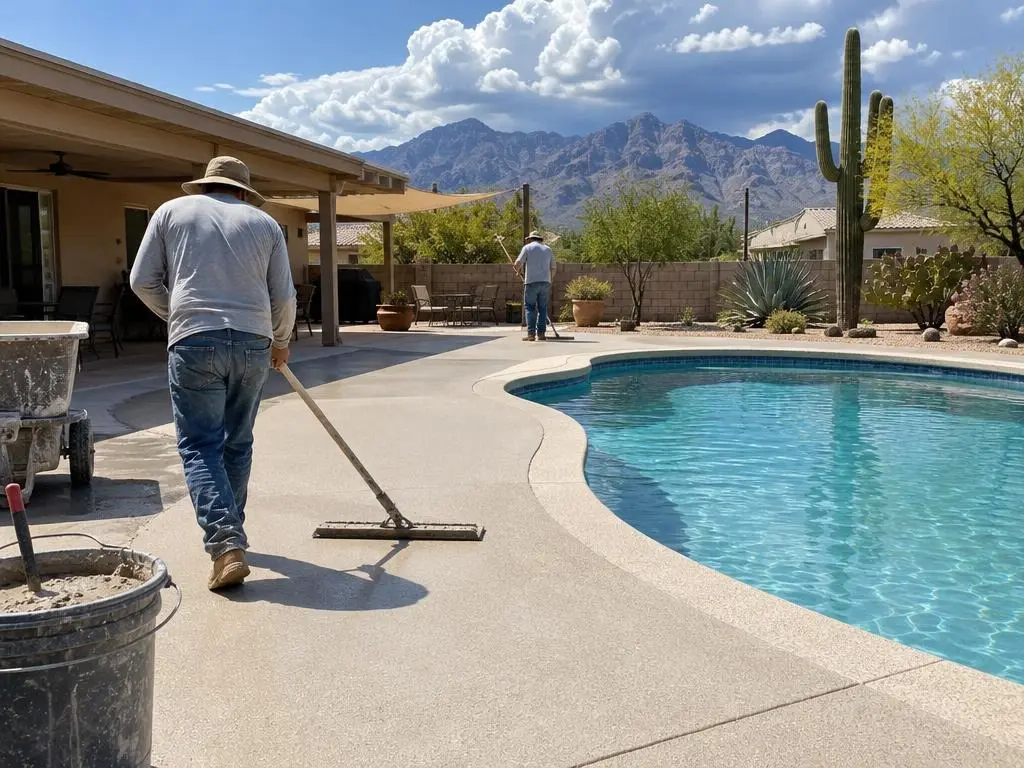
- Exposed aggregate: the top paste is washed away to show the stone. It hides tire marks and dust well.
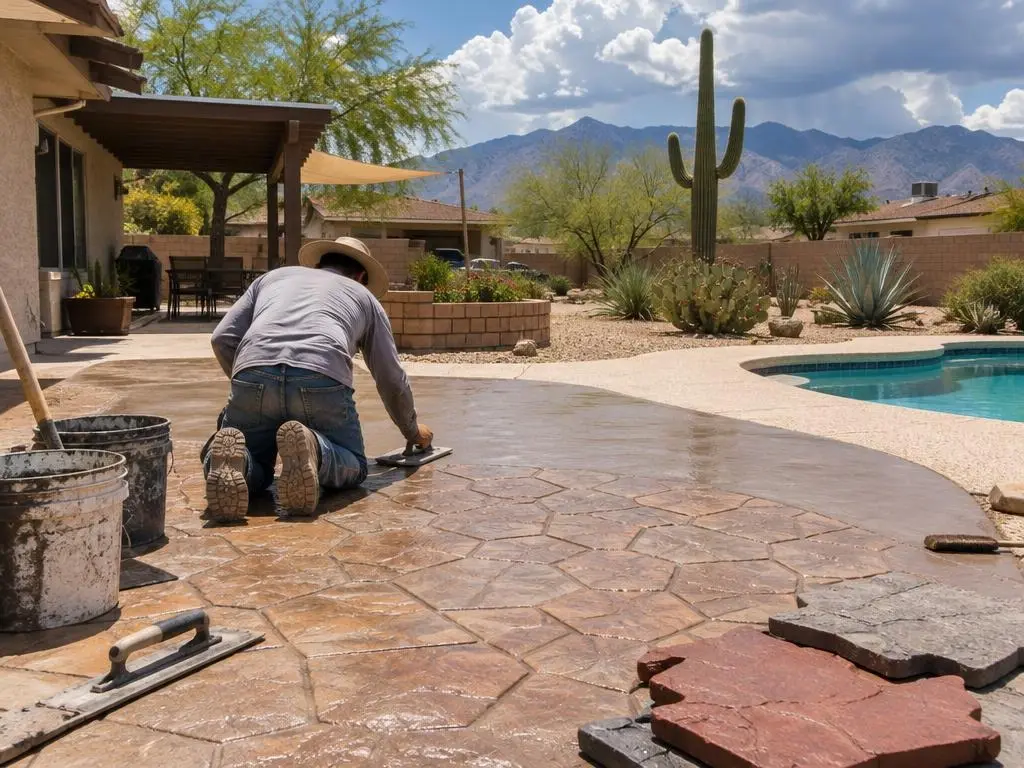
- Colored or stamped borders: a decorative band along the edges while the main lanes stay plain.
- Smooth trowel: clean looking but slick when wet, so we keep it off sloped driveways.
The first month
Keep cars off for at least seven days, and keep heavy vehicles off for about 30, per HomeGuide's driveway guide. The same guide recommends waiting 28 to 30 days before applying the first sealer and resealing every 2 to 3 years. Point downspouts and drip lines away from the new edges so water does not undercut them.
What the Driveway Price Covers
Each of these appears as its own line on the quote.
Removal and hauling
The old concrete, asphalt or pavers broken out and taken away, along with soft soil underneath.
Excavation and base
Digging to depth, including through caliche where needed, then a compacted base for even support.
Forms and slope
Forms set so the driveway drains toward the street and away from the garage.
Reinforcement
Rebar or wire mesh placed in the slab, matched to its size and load.
Pour, finish and joints
Concrete placed early in the day, finished, jointed on a planned layout and cured.
Aprons and side pads
Approaches at the street and extra width or pads for trailers, tied into the main slab.
Typical Concrete Driveway Costs
| Item | Published range |
|---|---|
| Standard driveway, per sq ft installed | $6 to $10 |
| One-car, 12 x 24 ft | $1,700 to $4,300 |
| Two-car, 20 x 20 ft | $2,400 to $6,000 |
| Two-car, 24 x 24 ft | $3,500 to $8,600 |
| Three-car, 24 x 36 ft | $5,200 to $13,000 |
| Old driveway removal, per sq ft | $2 to $6 |
| Rebar, per sq ft | $1 to $3 |
| Sealing, per sq ft | $1 to $3 |
Figures from HomeGuide's concrete driveway cost guide (national averages). Tucson pricing can be higher or lower, and size, access, removal and finish all change the total. Your written estimate after we measure is the price.
Start to Finish
1. Site visit
We measure, check drainage and the street connection, and give you a written quote.
2. Permit and removal
Any right-of-way permit is filed, then the old surface and soft soil come out.
3. Base and pour
The base is compacted, forms and steel set, and the concrete poured early in the day.
4. Cure and handoff
The slab is cured and you get written dates for driving and sealing.
Why Choose Us for Concrete Driveways
Built for what you park
Extra thickness where trailers, RVs or work trucks sit.
Street work permitted
Right-of-way permits filed before the pour is scheduled.
Concrete Driveways Questions
How long does a concrete driveway last?
HomeGuide gives 30 to 40 years for a well-built, maintained concrete driveway. The base, drainage, joint layout and regular sealing decide where in that range a driveway ends up.
How thick should my driveway be?
HomeGuide's guide calls for at least 4 inches for cars, 5 to 6 inches for RVs or heavy vehicles, and thicker edges. We add depth wherever heavier vehicles will park.
Can you pour new concrete over my old driveway?
We rarely recommend it. New concrete on top of a cracked, sunken slab tends to crack in the same places, and it raises the surface at the garage and the street. Removing the old slab and rebuilding the base is the reliable fix.
Do I need a city permit to replace my driveway?
Inside Tucson city limits, work in the public right-of-way, such as the apron, sidewalk or curb, needs a right-of-way permit from the city's transportation department. We check what your address needs and handle it.
Can I widen my existing driveway instead of replacing it?
Yes, if the existing slab is in good shape. We tie the new section to the old one so they do not drift apart, and we match the finish as closely as possible. Old and new concrete will look slightly different at first.
Concrete Driveways Service Areas
- Concrete Contractors in Tucson, AZ
- Concrete Contractors in Oro Valley, AZ
- Concrete Contractors in Marana, AZ
- Concrete Contractors in Sahuarita, AZ
- Concrete Contractors in Green Valley, AZ
- Concrete Contractors in Vail, AZ
- Concrete Contractors in Catalina Foothills, AZ
- Concrete Contractors in Casas Adobes, AZ
- Concrete Contractors in Tanque Verde, AZ
- Concrete Contractors in Drexel Heights, AZ
- Concrete Contractors in Flowing Wells, AZ
- Concrete Contractors in Catalina, AZ
- Concrete Contractors in Corona de Tucson, AZ
- Concrete Contractors in Valencia West, AZ
- Concrete Contractors in Avra Valley, AZ
- Concrete Contractors in Summit, AZ
- Concrete Contractors in South Tucson, AZ
- Concrete Contractors in Tucson Estates, AZ
- Concrete Contractors in Rita Ranch, AZ
- Concrete Contractors in Dove Mountain, AZ
- Concrete Contractors in SaddleBrooke, AZ
- Concrete Contractors in Picture Rocks, AZ
- Concrete Contractors in Three Points, AZ
- Concrete Contractors in Rillito, AZ
Get a Concrete Driveways Estimate
We measure your driveway and price it in writing, anywhere in Tucson and nearby.